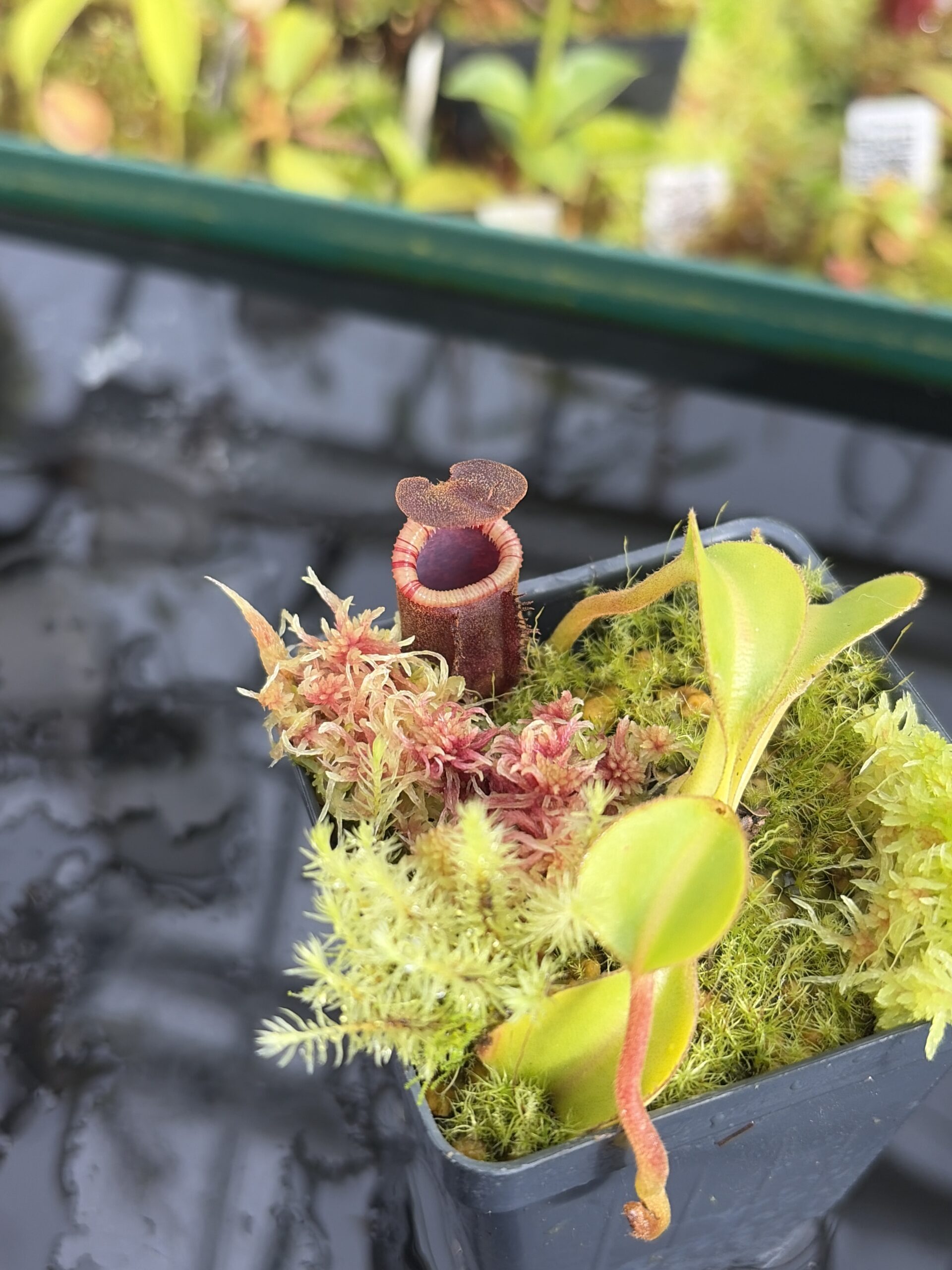
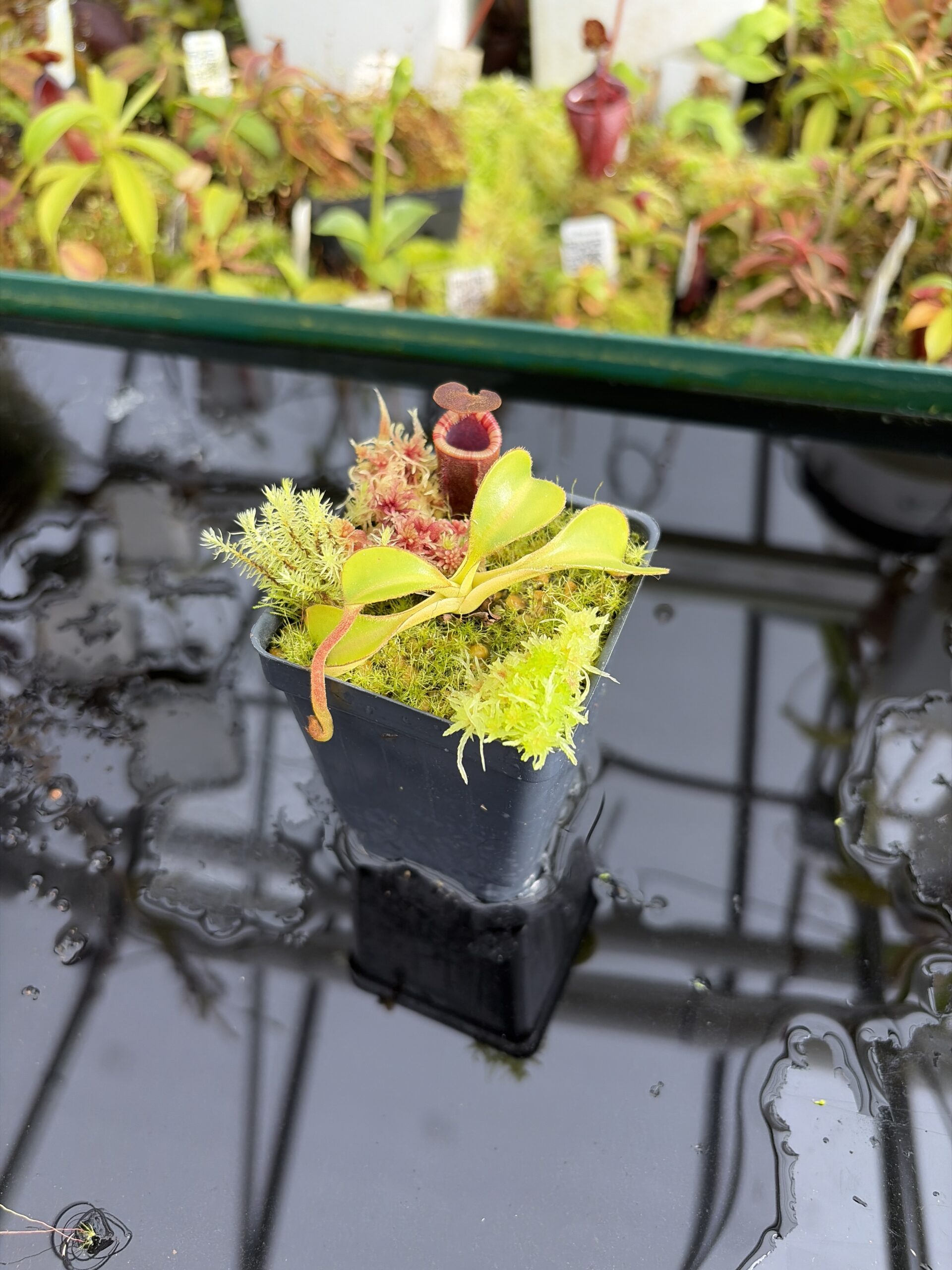
A northern Borneo highland species whose waisted, flaring upper pitchers and bristly lid are built to feed tree shrews rather than to catch insects.
N. lowii grows across the upper montane zone of northern Borneo at 1,650 to 2,600 m, on Sabah peaks including Kinabalu, Tambuyukon, Alab, Mentapok, Monkobo and Trusmadi, and across northern Sarawak and Brunei. It lives on nutrient-poor soils in mossy forest and stunted ridge-top vegetation, both on the ground and as an epiphyte. Hugh Low found it in 1851 on his first ascent of Kinabalu, and Joseph Hooker described it in 1859 and named it for him. It is listed as Vulnerable.
The upper pitchers are unmistakable: globose at the base, strongly waisted, then flaring into a wide funnel, with the peristome reduced to a series of ridges. They are rigid, almost woody, green outside and dark inside. The reflexed lid carries bristles up to 2 cm long and a white exudate the plant produces itself. Tree shrews feed on it and leave their droppings in the pitcher, and studies have found mature plants get 57 to 100% of their leaf nitrogen this way.