
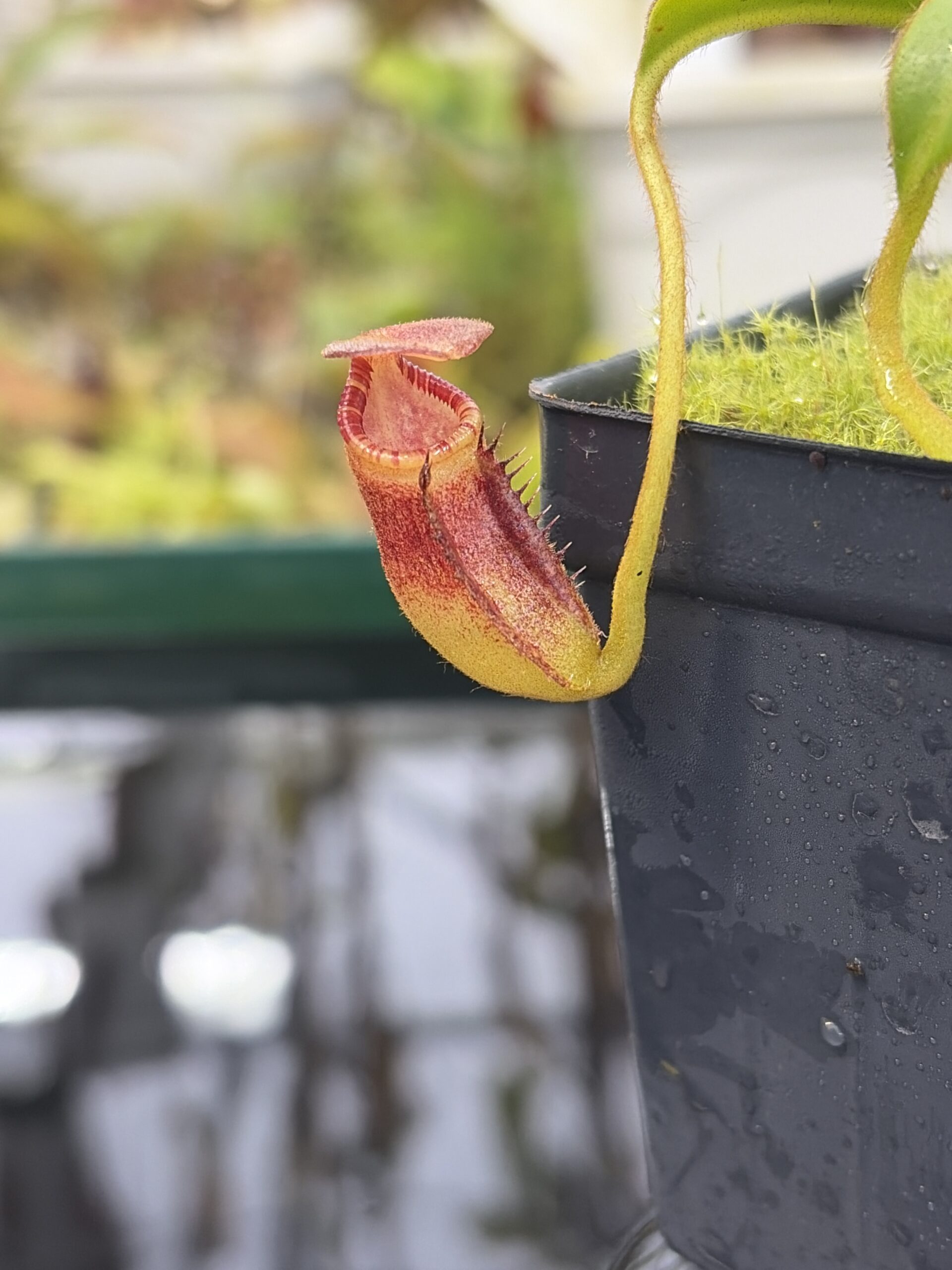
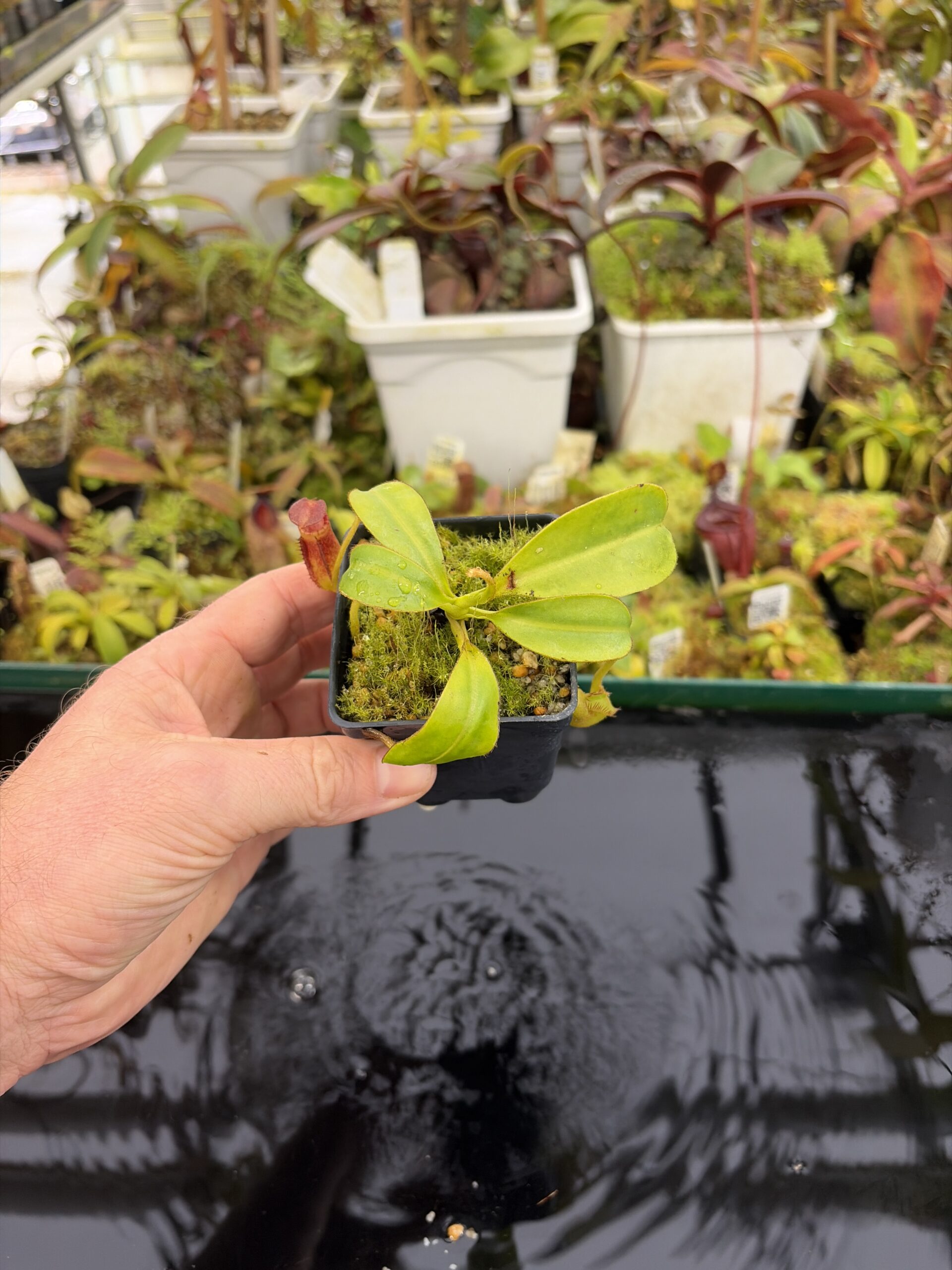
Nepenthes ephippiata

1 specimen in stock, $389.99. Each photo shows the exact plant you receive.

Nepenthes ephippiata, Clone 01, specimen H27602
Medium · Clone 01 · Andreas Wistuba
Choose a specimen

$389.99

Size
Medium
Clone
Clone 01
Locality
Gunung Raya, Borneo
Breeder
Andreas Wistuba
Producer code
AW-01
Conditions
Highland
Propagation
Tissue Culture
Specimen
H27602

Nepenthes ephippiata

The saddle-leaved pitcher plant of central Borneo, a close relative of N. lowii from montane forest at about 1,000 to 1,900 m.

Nepenthes ephippiata is endemic to Borneo. It grows in montane forest at about 1,000 to 1,900 m in the Hose Mountains of central Sarawak and on Mount Raya and Bukit Lesung in Kalimantan. B. H. Danser described it in 1928 in his monograph on the Nepenthes of the Netherlands Indies, working from nothing more than part of a stem and a fruiting spike. It is listed as Vulnerable.

The name comes from the Latin ephippium, a saddle cloth, and the common name is the saddle-leaved pitcher plant. It refers to the way the leaf base wraps the stem like a saddle, a feature that is fully developed only on climbing stems. Plants from the Hose Mountains that are not yet climbing show a less pronounced saddle than specimens from Central Kalimantan. Its closest relative is N. lowii. Compared with N. lowii, its upper pitchers are less constricted, the peristome is better developed, and the lid carries short tubercles instead of long bristles. No natural hybrids are known.

Specimens available now

Learn more about this plant

Localities

Nepenthes ephippiata from Gunung Raya

The Kalimantan form of the saddle-leaved pitcher plant, from Gunung Raya.

N. ephippiata is known from only three areas: the Hose Mountains of central Sarawak, and Mount Raya and Bukit Lesung in Kalimantan. Growers know two forms in cultivation, one from Gunung Raya and one from the Hose Mountains. The saddle that gives the species its name develops fully only on climbing stems. Non-climbing plants from the Hose Mountains appear to have leaf bases that run less far down the stem than plants from Central Kalimantan.

Breeders

Andreas Wistuba

German botanist and nurseryman who has described more than half of all known Heliamphora and many Nepenthes.

Andreas Wistuba is a German botanist from Maselheim who specializes in carnivorous plants. He is credited with describing more than half of all known Heliamphora species, among them H. hispida, H. folliculata and H. chimantensis, and in 2024 he co-described H. electrum. With Joachim Nerz and others he co-described Nepenthes including N. talangensis, N. flava and N. undulatifolia.

His nursery says that it has been in business for more than 25 years. It runs its own propagation laboratory and keeps a gene bank of rare species and forms.

Care

Growing highland Nepenthes

Cool nights, mild days, high humidity and steady airflow, the mountain cloud forest that most of our Nepenthes come from.

Highland Nepenthes grow in montane forest where nights cool down sharply after mild days. Aim for nights about 50 to 55 F (10 to 13 C), days 70 to 78 F (21 to 26 C), humidity above 70 to 80 percent, bright filtered light and constant airflow. The night drop is what highland plants need most; a warm room at night slows them down.

Grow them in an open, airy mix that drains fast, such as long-fiber sphagnum with perlite or bark, and keep it evenly moist with pure water (rain, distilled or reverse osmosis). Never let the pot sit in water for long.

New plants settle in over a few weeks; keep conditions steady while they do. The pitchers catch their own food, so fertilizer, if any, should be light and occasional.