
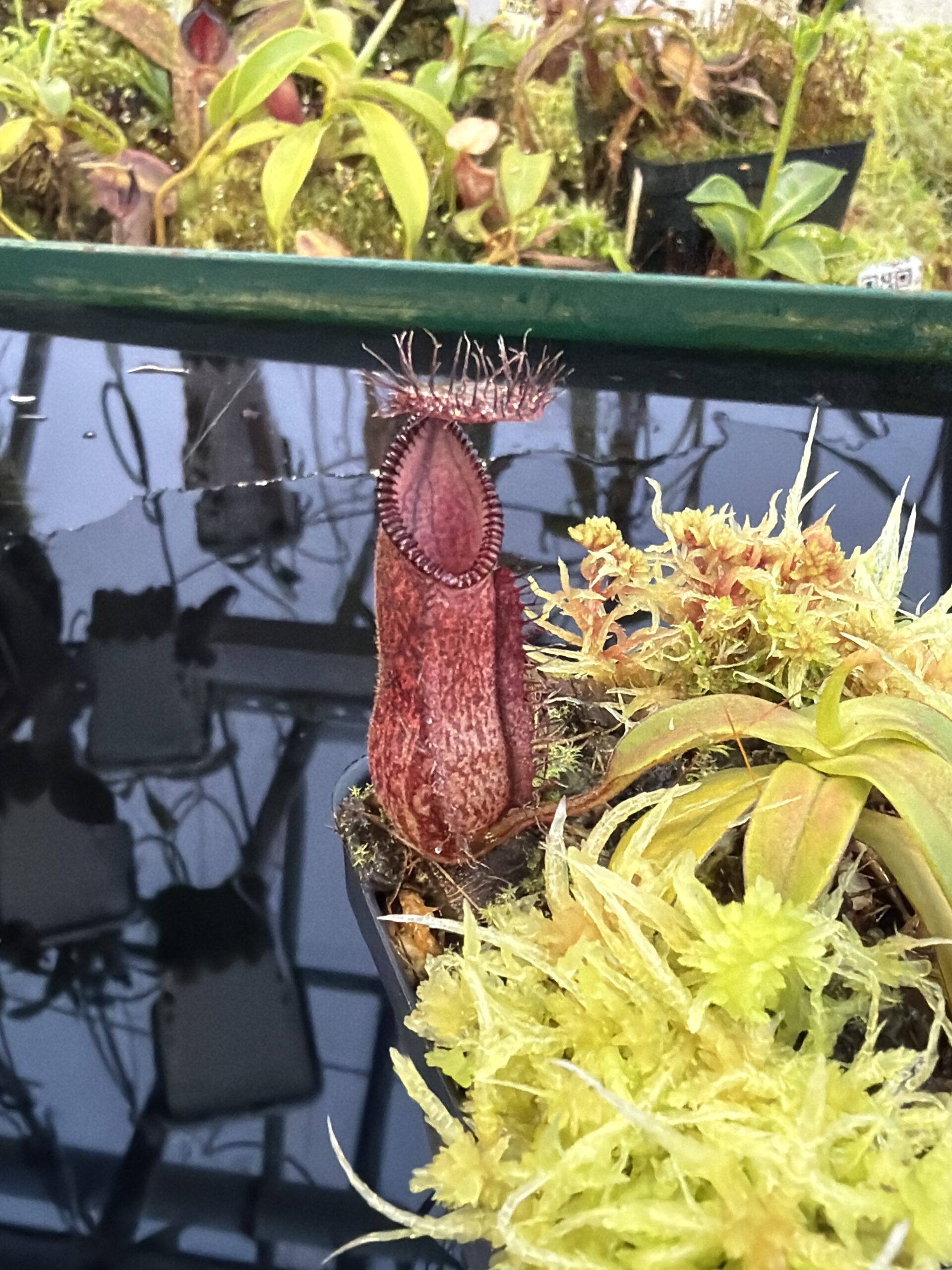
Nepenthes hamata
A Sulawesi highland species from 1,400 to 2,500 m with what may be the most developed peristome in the genus, armed with long, hooked teeth.
Nepenthes hamata is endemic to Sulawesi, recorded mostly from the eastern part of Central Sulawesi at 1,400 to 2,500 m. It grows in mossy forest and scrub on ridges and summits, on the ground or as an epiphyte, in high humidity and partial shade. Pierre Eyma collected it in 1938. In 1984 Shigeo Kurata published it as N. dentata and Turnbull and Middleton as N. hamatus; the name N. hamata prevailed. It is listed as Least Concern and occurs in Lore Lindu National Park and Morowali Nature Reserve. The red hairy form once grown as N. hamata was described in 2020 as N. diabolica.
N. hamata has what may be the most developed peristome in the genus, with ribs up to 6 mm high and sickle-shaped teeth reaching about 7 mm into the pitcher. Lower pitchers reach about 18 cm, swollen at the base, with fringed wings, and upper pitchers range from 7 to 25 cm. The lid can carry thread-like appendages up to 2 cm long, though they are often absent. Color varies widely, even on one mountain, and most populations are nearly hairless. The epithet means hooked, for those peristome teeth.