
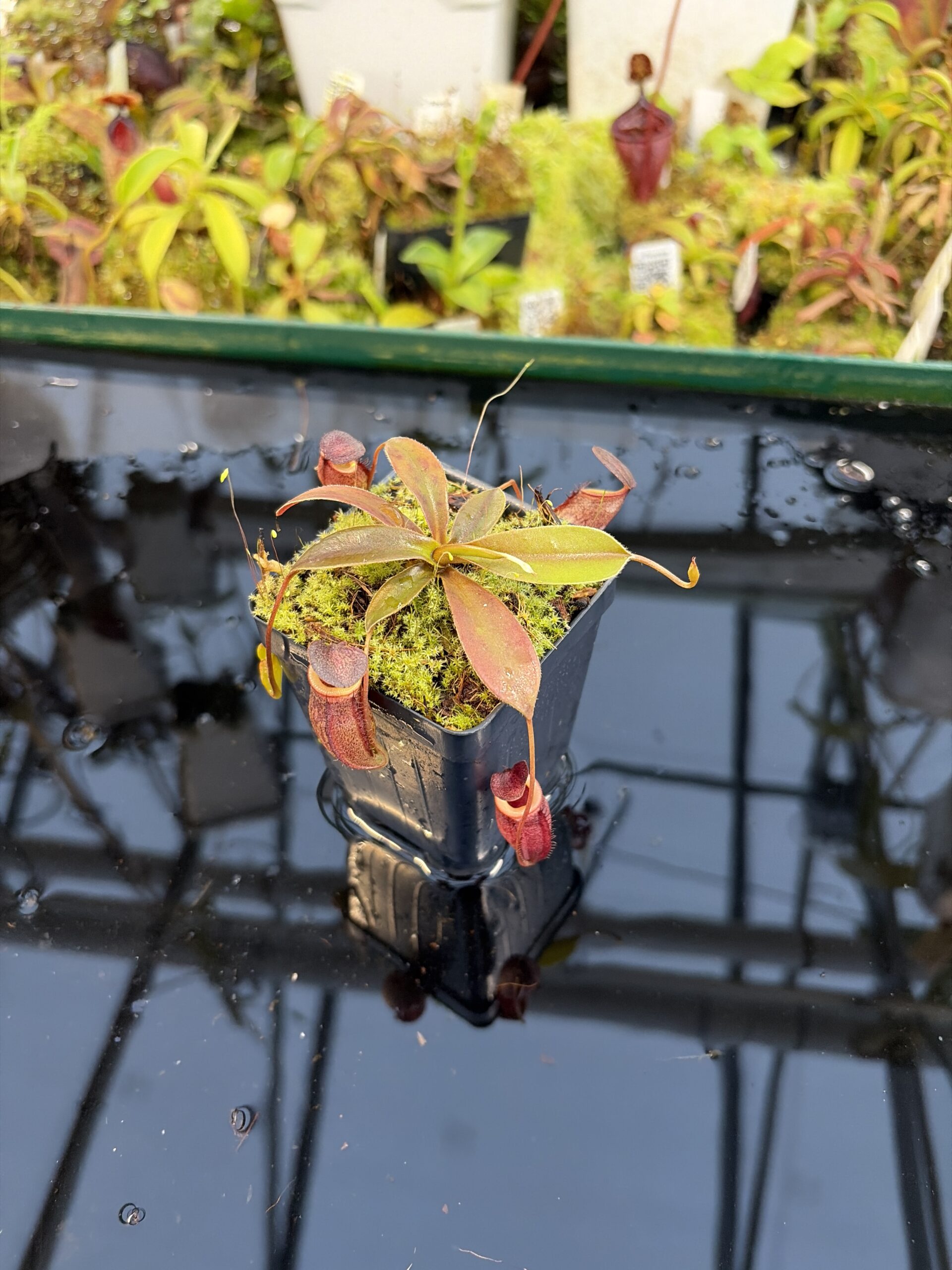
Nepenthes rajah × tenuis

None in stock right now.

Nepenthes rajah × tenuis, a past plant
A past plant, shown as an example. It has sold.

We don't have Nepenthes rajah × tenuis in stock right now. Subscribe below to hear about new plants.

Nepenthes rajah × tenuis

A study in extremes: N. rajah, with the largest pitchers in the genus, crossed with N. tenuis, a rare West Sumatran species with some of the smallest.

Borneo meets Sumatra. N. rajah is endemic to Mount Kinabalu and Mount Tambuyukon in Sabah, Borneo, at 1,500 to 2,650 m, only on ultramafic soils where groundwater seeps. N. tenuis is endemic to West Sumatra, where its one known population grows near Taram at about 1,000 to 1,200 m, in mossy forest on sandstone ridge tops, often half buried in moss.

N. rajah is known for the largest pitchers in the genus, with a broad, scalloped red peristome and a huge vaulted lid. N. tenuis sits at the other end of the scale: its upper pitchers are usually only 2.5 to 4.5 cm tall, yellow-green with red-brown blotches, and the name means slender. Nerz and Wistuba described it in 1994 from a 1957 herbarium specimen and photograph, and it was not seen again in the wild until 2002. Documentation on the cross itself is limited, so expect individual character.

Learn more about this plant

Breeders

Borneo Exotics

The Nepenthes nursery in Sri Lanka that Rob Cantley founded in 1997.

Borneo Exotics is a Nepenthes nursery in the central highlands of Sri Lanka. Rob Cantley founded it in 1997, and he runs it with his wife and business partner, Diana. It built its own tissue culture laboratory because cuttings proved inconsistent and prone to disease, and it now offers micropropagation services to breeders and nurseries around the world.

Its plants are sold under BE numbers, and other sellers keep those numbers on their listings. Cantley also found a new species in January 1997, on a trip to Mindanao to look for N. truncata seed. It was described in 2011 as N. robcantleyi in his honor, and nearly all plants in cultivation descend from a small batch of seedlings from that one trip.

Parents

Nepenthes rajah

The king of Nepenthes: endemic to Kinabalu and Tambuyukon on ultramafic soils, with the largest pitchers in the genus and a broad, toothed red peristome.

Nepenthes tenuis

One of the smallest-pitchered Nepenthes, a slender Sumatran climber known from a single sandstone ridge population and rediscovered in 2002.

Care

Growing highland Nepenthes

Cool nights, mild days, high humidity and steady airflow, the mountain cloud forest that most of our Nepenthes come from.

Highland Nepenthes grow in montane forest where nights cool down sharply after mild days. Aim for nights about 50 to 55 F (10 to 13 C), days 70 to 78 F (21 to 26 C), humidity above 70 to 80 percent, bright filtered light and constant airflow. The night drop is what highland plants need most; a warm room at night slows them down.

Grow them in an open, airy mix that drains fast, such as long-fiber sphagnum with perlite or bark, and keep it evenly moist with pure water (rain, distilled or reverse osmosis). Never let the pot sit in water for long.

New plants settle in over a few weeks; keep conditions steady while they do. The pitchers catch their own food, so fertilizer, if any, should be light and occasional.