
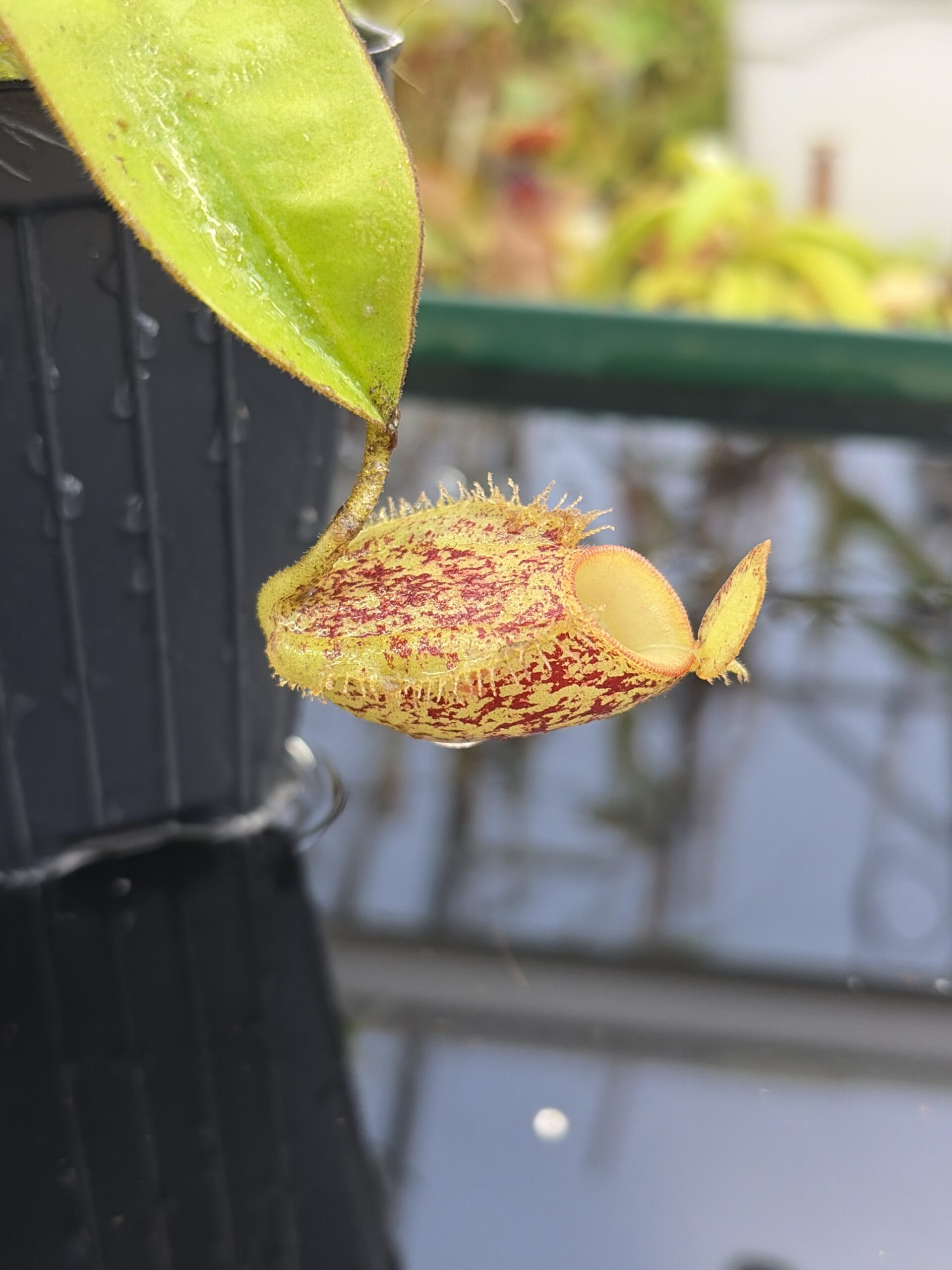
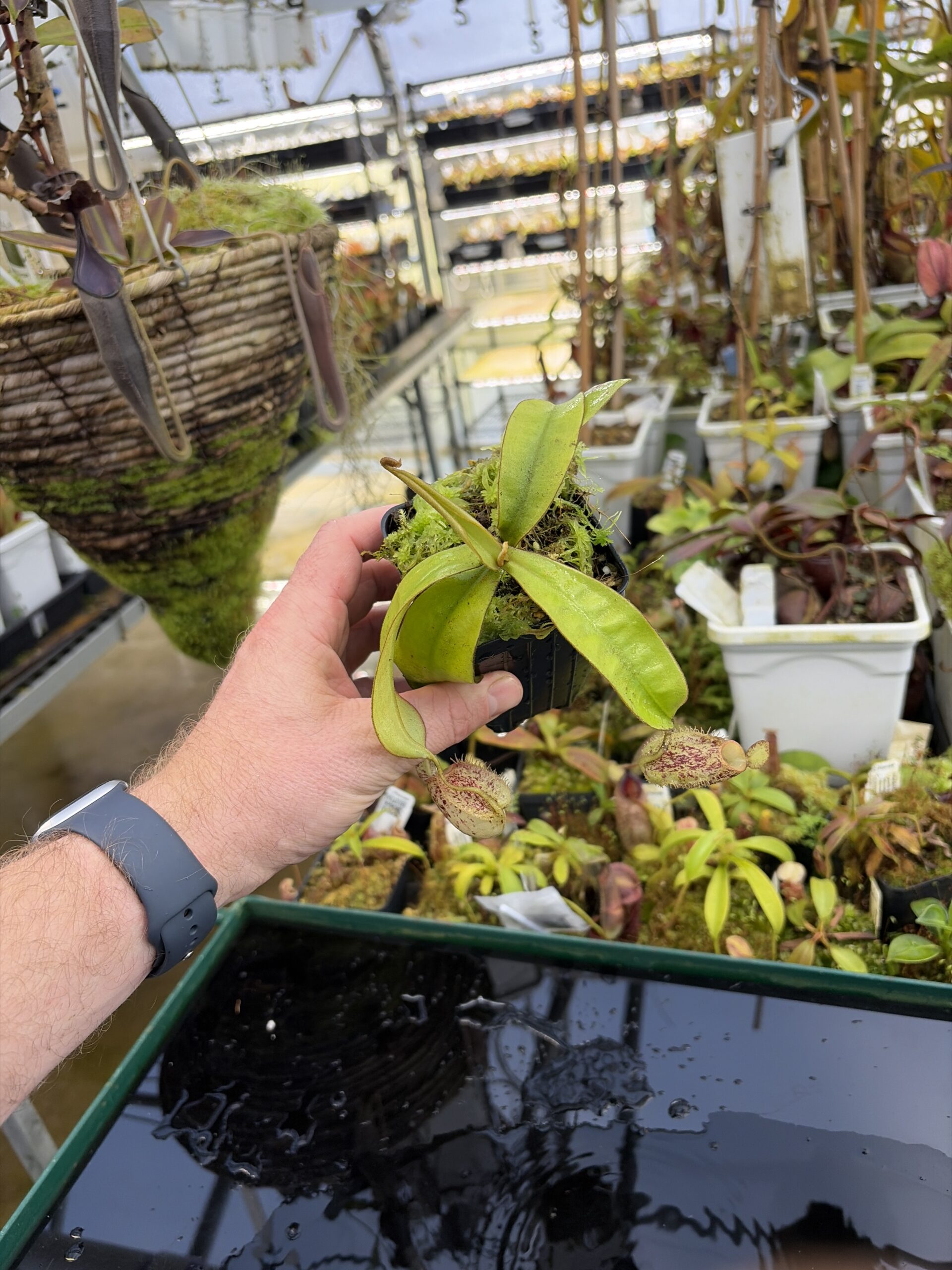
Nepenthes ampullaria

speckled, tricolor (Tayeve, Irian Jaya)

1 specimen in stock, $149.99. Each photo shows the exact plant you receive.

Nepenthes ampullaria, speckled, tricolor (Tayeve, Irian Jaya), specimen L27223
Large · Andreas Wistuba
Choose a specimen

$149.99

Size
Large
Locality
Tayeve, Irian Jaya
Breeder
Andreas Wistuba
Conditions
Lowland
Propagation
Tissue Culture
Specimen
L27223

Nepenthes ampullaria

A lowland Nepenthes of the Sunda region and New Guinea that carpets the forest floor with small, round, lidless-looking pitchers built to catch falling leaf litter.

Nepenthes ampullaria has one of the widest ranges in the genus: Borneo, Sumatra, Peninsular Malaysia, Singapore, southern Thailand, the Moluccas and New Guinea, plus many smaller islands. Most populations sit in the lowlands. On Borneo it grows mainly on flat ground below about 1,000 m, in kerangas, peat swamp and degraded swamp forest, always in damp, shady places. William Jack described it in 1835, and the name comes from the Latin ampulla, a flask.

The pitchers are small, round urns, rarely more than 10 cm tall, with a strongly incurved peristome and a tiny lid bent back away from the mouth. Color runs from light green to solid dark red with every speckled form in between; the red forms are mostly Bornean. The plant spreads by underground runners into dense carpets of rosettes, and upper pitchers are rare. That open mouth has a purpose. N. ampullaria has moved partly away from catching insects and toward digesting leaf litter that falls into its traps. One study estimated that about 36% of the nitrogen in shaded plants came from litter.

Specimens available now

Learn more about this plant

Breeders

Borneo Exotics

The Nepenthes nursery in Sri Lanka that Rob Cantley founded in 1997.

Borneo Exotics is a Nepenthes nursery in the central highlands of Sri Lanka. Rob Cantley founded it in 1997, and he runs it with his wife and business partner, Diana. It built its own tissue culture laboratory because cuttings proved inconsistent and prone to disease, and it now offers micropropagation services to breeders and nurseries around the world.

Its plants are sold under BE numbers, and other sellers keep those numbers on their listings. Cantley also found a new species in January 1997, on a trip to Mindanao to look for N. truncata seed. It was described in 2011 as N. robcantleyi in his honor, and nearly all plants in cultivation descend from a small batch of seedlings from that one trip.

Andreas Wistuba

German botanist and nurseryman who has described more than half of all known Heliamphora and many Nepenthes.

Andreas Wistuba is a German botanist from Maselheim who specializes in carnivorous plants. He is credited with describing more than half of all known Heliamphora species, among them H. hispida, H. folliculata and H. chimantensis, and in 2024 he co-described H. electrum. With Joachim Nerz and others he co-described Nepenthes including N. talangensis, N. flava and N. undulatifolia.

His nursery says that it has been in business for more than 25 years. It runs its own propagation laboratory and keeps a gene bank of rare species and forms.

Care

Growing lowland Nepenthes

Warm days and warm nights with high humidity, the tropical lowland forest these plants come from.

Lowland Nepenthes come from hot, humid forest near sea level, and they want warmth around the clock. Aim for days in the 80s F (27 to 32 C) and nights that stay in the 70s F (21 to 26 C), with humidity above 70 percent and bright, indirect light. Cold nights are what hold lowland plants back.

Grow them in an open, airy mix that drains fast and keep it evenly moist with pure water (rain, distilled or reverse osmosis). Good airflow keeps the warm, humid air from going stale.

Lowland plants are often vigorous once settled. The pitchers feed the plant; fertilizer, if any, should be light and occasional.